Tales from Telluride
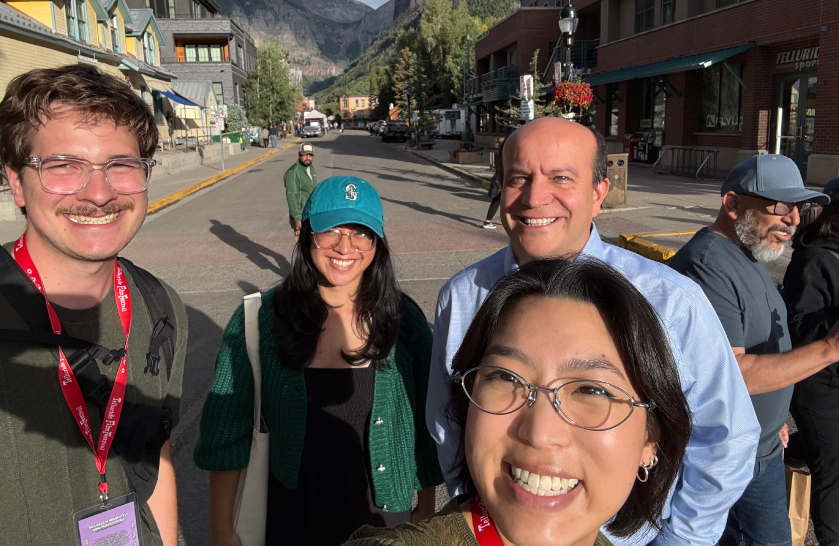
For over a decade, generous support from the Hamel family has allowed Communication Arts to send a professor and a small group of graduate students to the Telluride Film Festival in Colorado. This year’s group included Professor Jonathan Gray and graduate students Stephanie Chung (Film), Marianne Nacanaynay (Media and Cultural Studies), and Ethan Robinson (Film). Telluride keeps its screenings secret until the last minute, but is home to many US, North American, and even world premieres of films. Many of its films are usually lead contenders for Oscars, with notable contenders from 2025 like Bugonia and Hamnet. Attendees dive deep into contemporary film cultures and witness the near future of film.
Here are each of the attendees favorites from this year’s set of frills:
Stephanie Chung: Bucking Fastard
All of Werner Herzog’s films carry some kind of idiosyncrasy, but I’ve always been especially captivated by the inexplicably bizarre logic of Bad Lieutenant: Port of Call New Orleans. So, when I heard that Herzog’s new narrative fiction film Bucking Fastard would be screening at Telluride, I made attending that screening an absolute priority. Needless to say, Bucking Fastard was my favorite film at Telluride this year. Kate Mara and Rooney Mara excelled as the perplexing Holbrook twins, and it was lovely to see Orlando Bloom, cast as a delightfully sleazy ladies’ man, back on the screen. The film had me laughing throughout its runtime, and it was just so refreshing to sit back and dive into its nonsensical, fantastical world.
Bucking Fastard also stands out to me as one of my favorite theatergoing experiences. Watching the film at the Werner Herzog Theater on Herzog’s birthday felt like a real celebration of everything Herzog has made— Mara Fortes, the senior curator of the festival, even took a recording of the whole theater singing happy birthday to send to Herzog!
Jonathan Gray: Tender Loving Care
Mike Leigh’s Tender Loving Care once again highlights the director’s remarkable ability to explore issues that matter through charming, funny, wonderfully engaging dialogue and characters. If you liked Kate O’Flynn in Widow’s Bay, you’ll find her even more amazing here, matched by the equally luminescent Marion Bailey, Alice Bailey Johnson, and Paul Jesson. Perhaps fitting that as people murmured about this likely being the 83-year-old Leigh’s last film, it turns an eye towards end-of-life care. For me, the film offered a nice metaphor for Telluride: its two lead social workers witness so many people who are struggling, yet their family offers a bright, warm light, just as the festival itself provides a four-day warm respite from the ails of the world.
Aaron Greer: The Unknown and Fjord
This was my fifth year serving as the faculty co-leader of the Telluride Film Festival’s Student Symposium, which brings undergraduate and graduate students from all over the world to participate in an exhilarating program of screenings, discussions, and private Q&As with filmmakers.
It’s an intensive but exhilarating program where we see upwards of 4 films a day, and meet with a half-dozen filmmakers and actors. The films are always incredible. My favorites this year were probably The Unknown, which is a body-switch movie that was both narratively engaging and had me thinking more thoughts (and newer thoughts) about embodied identity than I have in a long time (and this in a world that’s not short of dialogue about gender identity), and Fjord, which was brilliantly and subtly crafted (I was 30 minutes into the film before I realized each scene was a long take) and asks important questions about the nature of fundamentalism of any kind (conservative OR liberal). That said, it’s really the environment of the festival generally and the Symposium specifically that makes the experience exceptional. It’s rare to be in a movie theatre (to be in a town) completely full of passionate cinephiles— everyone is at the festival (ticket holders, filmmakers, festival staff, students, volunteers, industry folks) because they really, really, really love movies. There are no red carpets, no markets, just movies.
While the screening experience is great, the secret sauce of the Symposium, and my favorite part, is the discussions I moderate with the students, who are all brilliant and passionate about film (despite the fact that many of them are studying different fields). These discussions and the elongated Q&As we get with filmmakers (this year we met w/ the directors of the above films, as well as Ken Burns, Ira Sachs, Rebecca Hall, and others) always deepen my understanding of the films and of cinema writ large. I always come back from the festival inspired by human ingenuity and rededicated to teaching and making film.
Marianne Nacanaynay: Elsinore
I really enjoyed Andrew Scott in King Lear, and was looking forward to seeing him in another Shakespeare role. This time it was in the biographical drama Elsinore as Ian Charleson in Hamlet, where Charleson is tapped to play the titular character for a London run of Hamlet at the National Theatre. Elsinore follows Charleson as he grapples with an AIDS diagnosis while beginning play rehearsals, and you see him navigate different and sometimes difficult relationships with family, friends, and colleagues. While Elsinore certainly has its heavier moments, Charleson is portrayed with a shrewd humor that hits you mid-tears; I’m an easy crier, but I was gratefully in good company in the theater as we ricocheted between crying and laughter. I left feeling freshly reminded of the labor people are willing to go through out of a love for art, and of the love others have for them to help carry them through.
Ethan Robinson: Tender Loving Care
Mike Leigh’s Tender Loving Care follows the lives of two social workers in the UK as they navigate the difficulties of work and family. The film’s emotional impact is strengthened by a series of standout performances by its cast members, particularly Kate O’Flynn, who is both hilarious and moving in her role as Amy. Filmed in a series of simple sets, the film has a polished low-budget quality which lends to its charming design and the intimate connection its characters foster with the audience. I am particularly drawn to the grounded storytelling and set design in this film because, as I teach production at the UW, it is easy to imagine my students creating a similarly impactful film with their limited resources.